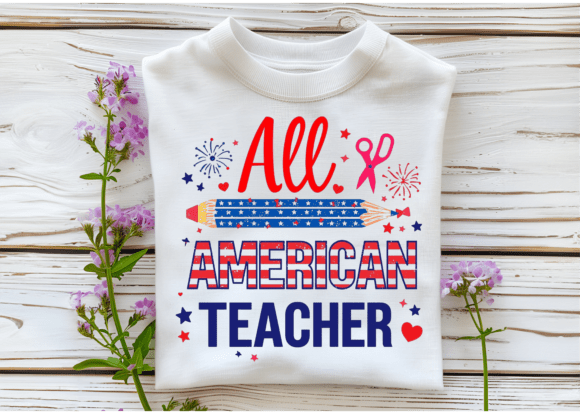
All American Teacher 4th of July T Shirt
I pulled up the All American Teacher 4th of July T Shirt file last week while prepping a batch of custom tote bags for a client who runs a small Etsy shop. She wanted something that felt celebratory but not costume-like, something a real teacher would actually wear to a barbecue or carry into a summer classroom cleanup day. The first thing that struck me was the balance between patriotic energy and everyday warmth. The graphic doesn't scream. It smiles. That's a rare quality in holiday-themed T-Shirt Designs, and it immediately made me think about how it would translate once thread hits fabric.
The Mood It Creates Before a Single Stitch Is Placed
Opening the zip file, I found the expected assets: JPG, PNG at 4500×5400 pixels and 300 dpi, plus PDF and SVG formats. Right away, the resolution told me this was built with print and digital mockup use in mind, but I was already imagining how the shapes would behave under a fill stitch or as a clean applique design. The composition feels grounded. There's a sense of structured pride without stiff formality. For an embroiderer, that means the visual weight is distributed well enough that you won't be fighting dense clusters in awkward corners, assuming the digitizing is done thoughtfully.
When I think about the teachers I know, they appreciate designs that feel personal but not overly delicate. They need something that can survive a spin in the washing machine and still look like a thoughtful handmade product. This graphic hits that note. The theme is overtly American, with a clear nod to educators, but the personality leans more toward grateful acknowledgment than loud patriotism. That matters because it widens the buyer pool. A customer shopping for a personalized gift wants something that feels intentional, not generic.
Where This Design Feels Most at Home
I tested a paper template placement on a medium-weight canvas tote and a soft cotton sweatshirt. On the tote, the scale felt immediately right. The proportions filled the front panel without creeping into the side seams, which is exactly what you want for a tote bag design that needs to read clearly at a craft fair table. On the sweatshirt, the design sat comfortably across the chest, leaving enough breathing room for the neckline and sleeve curves. This isn't one of those files that forces you to shrink it down to fit a standard hoop size and lose all the detail. At the provided dimensions, a well-digitized version would stitch out beautifully on a 5×7 or larger hoop.
I could also see this working on a kitchen towel, a pillow cover, or even a lightweight apron for a school fundraiser. The SVG File included in the download means you can scale it cleanly for different product types, which is a massive advantage if you're running a craft business with varied inventory. Scalability isn't just a convenience; it's a profit margin protector. You can take one Graphics asset and stretch it across mugs, posters, cards, and bags without losing quality.
Real Embroidery Concerns Nobody Talks About
Here's where I put my reviewer hat on firmly. Any design with thematic text elements and decorative accents needs a hard look at how it will actually stitch. I haven't seen the final stitch file, and the product description doesn't include a digitized embroidery file like PES or DST, only the flat graphic formats. That means you, the maker, are responsible for the digitizing step. I always advise running a test on scrap fabric first. The stitch density in the smaller details will make or break the finished piece. If the lettering is too tiny, you'll get thread buildup that turns words into unreadable blobs on textured fabric. If the decorative stars or flourishes are too compact, a satin stitch might pull the fabric inward, creating puckering on lightweight cotton.
For a sweatshirt embroidery project, I would lean toward a slightly reduced density and pair it with a quality cut-away stabilizer. The fleece backing on sweatshirts can swallow fine details, so you need that structural support. On a cap, I'd be cautious. The curved surface of a baseball hat demands a design that doesn't rely on perfect horizontal alignment. If the All American Teacher 4th of July T Shirt graphic has a strong horizontal baseline, you might need to adjust the digitizing to arc slightly for a natural look on headwear. This isn't a flaw in the design itself, just a practical consideration for commercial embroidery across different substrates.
Thread Color Choices That Make It Shine
One of my favorite exercises with a new machine embroidery design is building a thread palette before I even load the hoop. For this piece, I'd pull a rich navy blue, a slightly faded antique red, and a warm cream instead of a stark white. The slightly vintage red keeps the design from feeling like a mass-produced flag item. It adds a handmade warmth that buyers on Etsy respond to. If you're stitching on natural linen or oatmeal-colored fabric, the cream thread harmonizes in a way that bright white simply cannot. For dark fabric, think navy or charcoal, you'll want to bump up the contrast. A metallic gold thread for small accent stars could elevate the finished product dramatically, turning a simple shirt into a boutique gift item.
I also recommend testing the design in a black and white mockup. This reveals whether the contrast holds up without relying on color. If the shapes blend together in grayscale, you'll lose visual impact on a busy print or a textured fabric texture. Strong tonal separation is what makes an embroidered patch or a stitched gift look professional, not just homemade.
Product Types That Just Make Sense
If you're an Etsy seller or a small shop owner, you're always thinking about inventory diversification. This design lends itself to a curated collection rather than a one-off listing. Imagine a matching set: a teacher apron for the classroom, a coordinating tote for books, and a soft pillow cover for a reading nook. That kind of cohesive presentation builds brand consistency and increases average order value. The PNG Files and PDF give you the flexibility to create printable mockup previews that look polished, which is half the battle in online selling.
For baby embroidery or nursery decor, this might feel like a stretch, but I've seen far more unexpected placements. A tiny version on a baby onesie for a teacher's newborn, stitched with soft pastel threads instead of bold primaries, becomes a deeply personalized gift. The key is adjusting the stitch density and scale so the fabric remains soft against delicate skin. Always test on a similar lightweight fabric first.
What Gives Me a Little Pause
I'll be straightforward. The product description mentions using the design on POD sites for items like mugs, pillows, and bags, and the file types provided support that perfectly. But for embroidery use, there is no native stitch file included. That's not a dealbreaker, many digital embroidery file purchases start from vector or raster art. You just need to go in with clear eyes. If you're new to digitizing, the smaller decorative elements might require some manual cleanup to stitch cleanly. I'd recommend opening the SVG File in your digitizing software and checking the node count. Overly complex paths can lead to unnecessary trims and jumps, which slow down production and create a messy backside on the finished product.
Also, always confirm the licensing terms. The description states you can use it on POD sites, but if you plan to sell digitized embroidery files derived from this artwork, verify that's permitted. A quick message to the seller saves a lot of heartache later. Protecting your small shop product reputation means doing the paperwork, even when it's tedious.
Stitching It Into a Real-Life Scenario
Let me paint the picture that's been in my head since I first saw the design. I'm prepping for a July market. I have a stack of natural canvas aprons, and I'm stitching this design in navy and muted red on the upper bib. Next to it, I place a matching set of kitchen towels with the same design scaled down slightly. A customer walks up, a school principal, and she immediately picks up the apron. She tells me her entire third-grade team would adore these. She buys five on the spot. That's the power of a holiday embroidery design that understands its audience. It's not just a flag graphic. It's a conversation starter, a recognition tool, a small piece of wearable appreciation.
For apparel decorators, this file slots neatly into a summer lineup. It works for custom apparel orders, teacher appreciation week gifts, and even Fourth of July family reunion shirts where one member is a beloved educator. The buyer engagement potential is high because the niche is specific but not exclusionary. You don't have to be a teacher to buy it; you just have to know and love one.
Practical Reminders for Your Next Embroidery Project
Before you load the hoop, take a breath and run through the checklist I keep taped to my studio wall. Test the design on a fabric scrap that matches your final product weight. Check the thread colors under natural and indoor light. Review the hoop size requirement against your machine's capabilities. If you're stitching on a stretchy garment, use a fusible mesh stabilizer to prevent distortion. Inspect any small lettering or decorative dots at actual size, not just on screen. What looks crisp at 300 dpi on a monitor can blur into disappointment under thread. Trust me, I've learned that the hard way.
The All American Teacher 4th of July T Shirt gives you a strong foundation. It's a well-composed piece of Graphics work that translates cleanly into a variety of design assets for your business. Whether you're building a new embroidered patch line, refreshing your handmade product catalog, or creating a one-off personalized gift for a retiring teacher, this file earns its place in your library. It's not flashy. It's not trendy. It's just solid, useful, and likely to make someone feel genuinely seen. In a market flooded with generic clip art, that quiet confidence is worth every stitch.